Swordfish(Xiphias gladius)
Quick Facts
- Other Names: Broadbill
- Size Range: The swordfish can grow over 1,000 pounds, but smaller versions (100 to 400 pounds) are much more common.
- Native Species?: Yes
- Food Value: Long-time target of commercial fishermen due to its popular steak-like flesh. Very good by most standards.
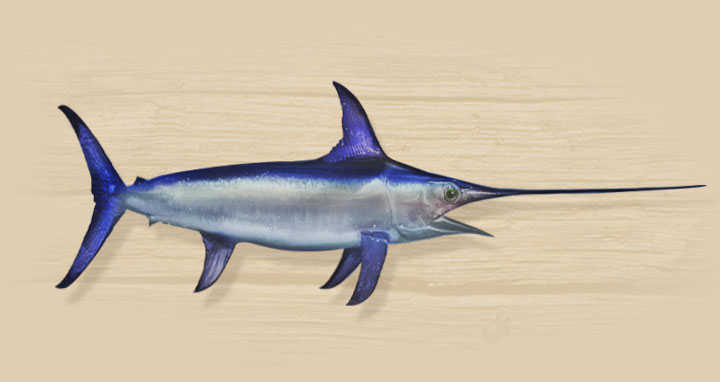
Different from the other billfish, the swordfish has a flattened and enlongated bill, a single high dorsal fin, and a distinct keel on the side of the tail. Swords are soft skinned, large eyed fish accustomed to feeding at great depths in the day and near the surface at night.
Swordfish are found in temperate and tropical oceans in offshore waters from the surface to depths up to 2,000 feet.
Live and dead baits drifted at night have been a long-time method for targeting swordfish. A daytime fishery has blossomed—anglers send baits to the depths with large, breakaway weights and hook fish down deep where they spend the daylight hours. This method is done with electric and conventional reels.
Swordfish Rules and Regulations
| Size Limit : | 29” min carcass length or 33 lbs. min dressed weight |
| Bag and Possession Limit : | 5 per vessel per trip |
| Seasons : | Finfish |
| Special Rules : | Recreational fishing vessels shall not possess more than five swordfish per vessel per trip. Swordfish taken under a recreational bag limit shall not be sold, purchased, exchanged, bartered, or attempted to be sold, purchased, exchanged or bartered. No person aboard any vessel shall transfer or cause the transfer of swordfish between vessels on state or federal waters. |
All recreational anglers, including those not normally required to have a fishing license, and charter captains must obtain a Recreational Offshore Landing Permit to possess swordfish.
Recreational fishing vessels shall not possess more than five swordfish per vessel per trip. Swordfish taken under a recreational bag limit shall not be sold, purchased, exchanged, bartered, or attempted to be sold, purchased, exchanged or bartered. No person aboard any vessel shall transfer or cause the transfer of swordfish between vessels on state or federal waters.
There are Currently No Videos to Display
Related Fishing Methods
Dead Bait
Dead bait consists of many different types of bait that is no longer alive. Dead bait is still attractive to many fish as they are normally feeding by smell and dead bait is the ticket for smell. Fresh cut fish, dead shrimp, half crab, shucked clam, cut squid and all popular examples of bait that will catch a wide variety of fish. Many sport fish that are predators, will gladly take the opportunity to slurp up a fresh dead bait. A redfish is equally happy to chase down a baitfish or slurp up a dead shrimp on the bottom. Dead bait has the benefit is being easy to obtain, maintain and transport, as opposed to live bait which takes livewells, quality water control and can be harder to obtain.
Drift Fishing
Drift fishing can encompass a variety of fishing methods. Bottom fishing over structure is often done while drifting. Timing the drop of your baits as you pass by the structures below is the trick. Also knowing when you have drifted beyond the fish is a key element to being succesful. Anglers also drift while live bait fishing and chunking for bluewater pelagic fish like tuna. The use of live bait or chunks is a slower presentation where the fish are drawn to the boat by smell or vibration of live fish. Inshore you can drift along while casting for trout and redfish with baits or lures. One of the main benefits of drift fishing is that you can quietly cover ground while searching for feeding fish.
Live Bait
Live bait is a term given to many different types of fish, crustaceans, insects and worms that are popular food items for fish and used by fishermen for bait. There are many benefits to live bait as well as a few cons. The pros normally out weigh the negatives, and live bait is widely used. The biggest benefit for fishermen is that they are using the real thing and often puts a fish's guard down. Small fish, crabs, shrimp, clams, crickets and the good ole earthworm are all used to entice a fish to the hook. The only negatives to live bait is just that, keeping it alive. Sometimes catching it can be a challenge, as only some species can be bought as live bait. No matter how you get it, live bait is a great way to target many types of fish.
Related Fishing Gear
Bridle
This is a method of using a small loop of line to secure a hook to a live baitfish. A bait needle is required to pass the loop, attached to the hook, through the eye socket of the fish.