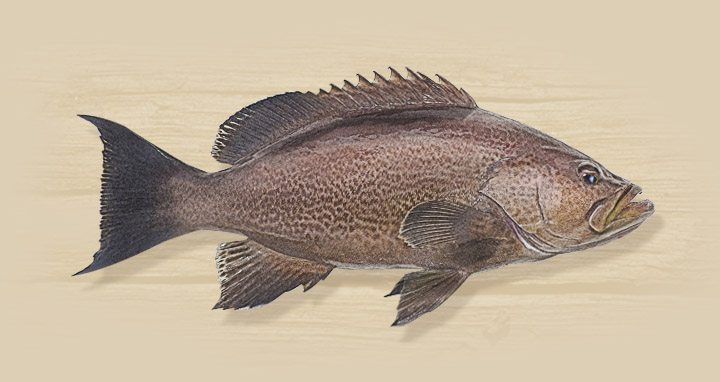
Scamp(Mycteroperca phenax)
Quick Facts
- Size Range: They can reach a length of 43 inches and a weight of 36 pounds.
- Native Species?: Yes
- Food Value: Highly prized for its delicate white and mild flesh.
State Record
- Louisiana State Record: 33.75lbs
- State Record Date: 6/1/2003
- State Record Holder Keith Gulino
A member of the grouper family, scamp can live up to 25 years. Scamp are aggressive predators and will swallow crabs, shrimp and other fish whole. Their distinct elongated tail fins make them easy to identify. They are light brown to tan and covered with speckles. They also have yellow coloration inside their mouth, similar to the yellowmouth grouper.
The scamp inhabits continental shelf waters from the Campeche Banks in the Gulf of Mexico to Florida and northward along the East Coast to North Carolina. They are often caught in the legs of oilrigs.
They are caught bottom fishing using live and cut bait or by jigging. They don’t fight as hard as some other grouper, but are prized for their great eating.
Scamp Rules and Regulations
| Size Limit : | 16” min total length |
| Bag and Possession Limit : | 4 daily in aggregate |
| Seasons : | Finfish |
All recreational anglers, including those not normally required to have a fishing license, and charter captains must obtain Recreational Offshore Landing Permit to possess grouper.
There is a closed season for the recreational harvest of gag from January 1 through June 30. A closed season for the recreational harvest of black, red, yellowfin and yellowmouth groupers as well as rock hind, red hind and scamp has also been established from Feb. 1 - March 31 of each year. Size, bag and possession limits have been removed for rock hind, red hind, misty grouper, black sea bass, dog snapper, mahogany snapper, schoolmaster, blackline and anchor tilefish.
Other seasons and rules are currently in place in Federal waters off of Louisiana. Please check those rules at www.gulfcouncil.org under “Fishing Regulations.”
There are Currently No Videos to Display
Related Fishing Methods
Bottom Fishing
Bottom fishing is normally about fishing bottom structures in order to target benthic or bottom dwelling fish. There are a wide variety of techniques, but the common element is the targeting of species who dwell around or hide in natural and man-made structures. Fish like grouper, snapper, amberjack and catfish would be considered bottom fish. It is very popular amongst anglers and success is often determined by the fishermen's ability to crank a fish away from the structure before the fish can duck into it and cut the line. Anchoring or drifting the boat over the structure is key to having success. There are many versions, and many of the bottom fish are prized eating.
Dead Bait
Dead bait consists of many different types of bait that is no longer alive. Dead bait is still attractive to many fish as they are normally feeding by smell and dead bait is the ticket for smell. Fresh cut fish, dead shrimp, half crab, shucked clam, cut squid and all popular examples of bait that will catch a wide variety of fish. Many sport fish that are predators, will gladly take the opportunity to slurp up a fresh dead bait. A redfish is equally happy to chase down a baitfish or slurp up a dead shrimp on the bottom. Dead bait has the benefit is being easy to obtain, maintain and transport, as opposed to live bait which takes livewells, quality water control and can be harder to obtain.
Deep Jigging
Deep jigging is a method of fishing using heavy lead head jigs with rubber or hair for tails. They are often tipped with a strip of fish or squid and dropped to the depths. A series of vertical bounces entices a fish into striking the lure. Grouper, snapper and amberjacks are often caught with this method. It is a workout, but worth it when it all comes tight. Metal jigs in combinations with braided line, have gained a prominent place in the tackle box of most fishermen working the depths.
Jigging
A versatile method of fishing for many types of fish in both freshwater and salt. A jig is a lure, normally a lead-headed lure with many various types of body/tail configurations made of rubber, hair and feather. Jigs are one of the most versatile of all lures and can be tipped with bait or not. Traditionally jigs are worked in variety of up and down motions, and can be fished throughout the entire water column, depending on the fishery. A modern form of jigs called metal jigs has taken hold and many varieties and shapes have been developed to work different ways. Made famous by the Shimano Butterfly Jig and now produced by many companies in many variations. If I could only have one lure to fish with it would be a jig.
Live Bait
Live bait is a term given to many different types of fish, crustaceans, insects and worms that are popular food items for fish and used by fishermen for bait. There are many benefits to live bait as well as a few cons. The pros normally out weigh the negatives, and live bait is widely used. The biggest benefit for fishermen is that they are using the real thing and often puts a fish's guard down. Small fish, crabs, shrimp, clams, crickets and the good ole earthworm are all used to entice a fish to the hook. The only negatives to live bait is just that, keeping it alive. Sometimes catching it can be a challenge, as only some species can be bought as live bait. No matter how you get it, live bait is a great way to target many types of fish.
Vertical Jigging
Vertical jigging popular and growing trend of using a variety of metal jigs and high speed reels to quickly drop and retrieve the jig making it dance or flutter through the water column. It is deadly on a wide variety of fish. Both bottom fish and pelagics are fooled into biting these versatile jigs.