Bigeye Tuna(Thunnus obesus)
Quick Facts
- Size Range: Over 350 pounds
- Native Species?: Yes
- Food Value: Excellent eating
State Record
- Louisiana State Record: 197.25lbs
- State Record Date: 11/1/2009
- State Record Holder George Graham
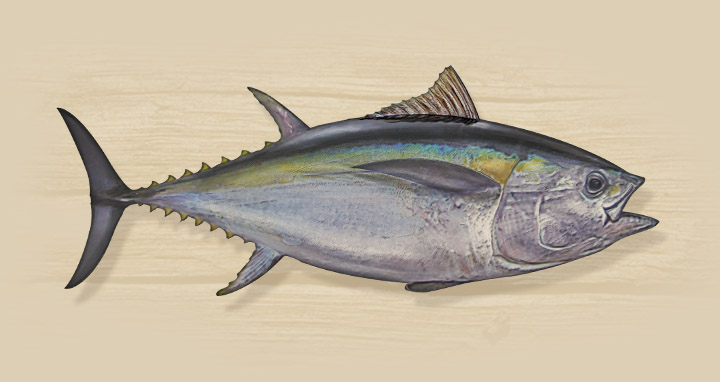
Bigeye are large growing tuna with a dark black back and yellow fins and finlets. The black back turns to silvery grey sides and a silver belly. Bigeye are very similar to yellowfin tuna, but their fins are not as long and they have some internal differences. They have a larger eye than most other tuna, resulting in their name.
They inhabit open offshore waters in schools and sometimes travel or feed with other species of tuna such as the yellowfin.
They are taken trolling natural and live bait as well as lures or by chunking cut bait. In many areas, they are not as common as other tuna, making them a prized catch. They are more commonly caught in the waters of the northeast U.S.
Bigeye Tuna Rules and Regulations
| Size Limit : | 27” minimum curved fork length |
All recreational anglers, including those not normally required to have a fishing license, and charter captains must obtain a Recreational Offshore Landing Permit to possess tuna.
Anglers fishing for tunas within or outside Louisiana state waters are subject to both state and federal laws, rules and regulations. Federal regulations regarding the recreational harvest of tunas change often, especially for bluefin tuna. Prior to angling for or harvest of tuna, be aware of the most current federal regulations for fishing or harvest, including sizes, bag limits and closed seasons. For updates on tuna quota monitoring and tuna retention limit adjustments, anglers may call the Atlantic Tunas Information Line at 888-872-8862. The “Atlantic Tunas Regulations Brochure” is available at http://hmspermits.noaa.gov/ library.asp and announcements of changes may be accessed via the web at http:// hmspermits.noaa.gov/news.asp.
Permanent Louisiana regulations on tuna harvest may be superseded by seasonal changes within the federal regulatory system. See websites referenced above for current federal regulations.
Bluefin Tuna
All bluefin tuna must be reported within 24 hours of landing to NMFS by calling 888-872- 8862 or visiting www.hmspermits.noaa.gov. For further information about angling category permits call the NMFS HMS Division at 888-872-8862 or 301-713-2347.
There are Currently No Videos to Display
Related Fishing Methods
Chunking
The use of chunks of cut bait, usually fish, to attract game fish to the boat. The hook is then placed in one of the chunks and tossed out to free-line down. Also could be considered chumming, but the size of the pieces are bigger and gives the fish something to start feeding on.
Drift Fishing
Drift fishing can encompass a variety of fishing methods. Bottom fishing over structure is often done while drifting. Timing the drop of your baits as you pass by the structures below is the trick. Also knowing when you have drifted beyond the fish is a key element to being succesful. Anglers also drift while live bait fishing and chunking for bluewater pelagic fish like tuna. The use of live bait or chunks is a slower presentation where the fish are drawn to the boat by smell or vibration of live fish. Inshore you can drift along while casting for trout and redfish with baits or lures. One of the main benefits of drift fishing is that you can quietly cover ground while searching for feeding fish.
Live Bait
Live bait is a term given to many different types of fish, crustaceans, insects and worms that are popular food items for fish and used by fishermen for bait. There are many benefits to live bait as well as a few cons. The pros normally out weigh the negatives, and live bait is widely used. The biggest benefit for fishermen is that they are using the real thing and often puts a fish's guard down. Small fish, crabs, shrimp, clams, crickets and the good ole earthworm are all used to entice a fish to the hook. The only negatives to live bait is just that, keeping it alive. Sometimes catching it can be a challenge, as only some species can be bought as live bait. No matter how you get it, live bait is a great way to target many types of fish.
Trolling
Trolling is the presentation of lure and/or baits from a moving boat. Many types of predatory fish are caught this way in both fresh and salt water. Speeds and presentations vary greatly depending on the target species. One may troll a small beetle spin for crappie with trolling motor in the lake, or charge around oil rigs at 15 knots with a high-speed wahoo spread. Trolling ballyhoo offshore is one of the most common, broad spectrum ways to catch all types of gamefish. Again there are many different methods to choose from.